All fact sheets · The Strata Memo
Ruthenium
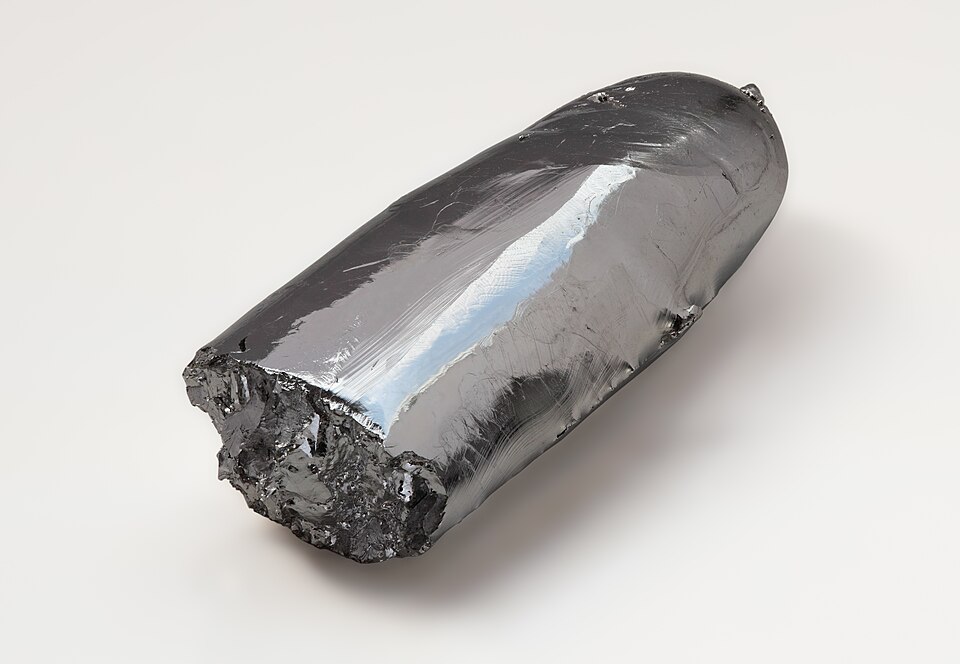

Hover, focus or tap to see the real thing
Photo Alchemist-hp ( talk ) ( www.pse-mendelejew.de ). “Ruthenium a half bar.jpg.” FAL. Wikimedia Commons. File page
Chemical details
- State at room conditions
- Solid
- Melting point
- 2,607 K (2,334 °C)
- Boiling point
- 4,423 K (4,150 °C)
- Density
- 12.1 g/cm³
- Common oxidation states
- +3
- Electronegativity (Pauling)
- 2.2
- Atomic radius
- 207 pm
- First ionization energy
- 7.361 eV
- Discovered
- 1827
Source: U.S. National Library of Medicine, PubChem, Periodic Table of Elements (element Ruthenium) (current at retrieval)
On the USGS 2025 List of Critical Minerals. Figures: USGS Mineral Commodity Summaries 2026 (data release, public domain). Estimates are USGS's; check the USGS chapter for notes. Each panel names its source; full citations are in the methodology source register.
Overview
The headline numbers: how much the U.S. depends on imports and how concentrated supply is.
Did you know?
Ruthenium takes its name from Ruthenia, the Latin name for Russia; Karl Claus confirmed the element in 1844.
Checked against two independent sources. Verified 2026-10-26.
Sources: Wikipedia · Los Alamos National Laboratory periodic table (Wikipedia text is CC BY-SA)
Supply
Who produces it, where the reserves are, where U.S. imports come from, and how U.S. supply has moved.
Price
Price, dollars per troy ounce: Ruthenium
Source: U.S. Geological Survey, Mineral Commodity Summaries 2026: Ruthenium (February 2026)
Where U.S. imports come from
Choose a data set, then a view. A country keeps the same color in every chart on this page. Grey means other countries, or a country beyond the seven colors (always labeled). Hover or focus a mark for its value, or use the table view.
- South Africa50% · $5.2B
- Germany11% · $1.1B
- Belgium8% · $870.9M
- Russia7% · $732.9M
- Switzerland6% · $630.6M
- Italy4% · $370.6M
- All other countries14% · $1.4B
| Country | U.S. imports, 2025 | Share of this chart |
|---|---|---|
| South Africa | 50% · $5.2B | 50.5% |
| Germany | 11% · $1.1B | 10.6% |
| Belgium | 8% · $870.9M | 8.5% |
| Russia | 7% · $732.9M | 7.1% |
| Switzerland | 6% · $630.6M | 6.1% |
| Italy | 4% · $370.6M | 3.6% |
| All other countries | 14% · $1.4B | 13.7% |
U.S. general imports (customs value) in calendar 2025 under HS 7110; countries beyond the top six are grouped. The code can include goods beyond this mineral. The Shift view compares each country's share of 2025 with its share of Jan to Aug 2026 (shares of each period's total).
Source: U.S. Census Bureau, International Trade API: U.S. imports by HS code and country (calendar 2025; Jan to Aug 2026) (data months 2025-12, 2026-08)
Trade and tariffs
Tariff codes and the countries behind U.S. imports and exports.
Trade codes and tariffs
| HTS code | What it covers | Normal rate | Column 2 rate |
|---|---|---|---|
| 7110 | Platinum, unwrought or in semimanufactured forms, or in powder form | Free * | Free |
Rates from the U.S. Harmonized Tariff Schedule (USITC, saved 2026-10-26). The normal rate is column 1 general; column 2 applies to countries without normal trade relations. A range means different products under the code have different rates. An asterisk means the schedule footnotes point to Chapter 99 additional-duty headings. Section 232, Section 301, emergency tariffs and antidumping or countervailing duties are set in separate notices and are not shown. Look up any code at hts.usitc.gov. These are the main codes for this mineral, not a complete list.
Source: U.S. International Trade Commission, Harmonized Tariff Schedule of the United States, general and column 2 rates (edition current when saved)
U.S. trade by country
U.S. imports in 2025 by source country, code 7110
| Name | Value |
|---|---|
| South Africa | 50% · $5.2B |
| Germany | 11% · $1.1B |
| Belgium | 8% · $870.9M |
| Russia | 7% · $732.9M |
| Switzerland | 6% · $630.6M |
| Italy | 4% · $370.6M |
U.S. exports in 2025 by destination, code 7110
| Name | Value |
|---|---|
| Canada | 18% · $1.1B |
| Italy | 17% · $1.1B |
| Germany | 13% · $841.8M |
| United Kingdom | 13% · $826.8M |
| Japan | 10% · $642.8M |
| Switzerland | 7% · $454.2M |
7110 Platinum, unwrought, semimfr forms or in powder fm
Top import sources South Africa 50%, Germany 11%, Belgium 8%
Top export destinations Canada 18%, Italy 17%, Germany 13%
U.S. Census Bureau International Trade API, saved 2026-10-26. Imports are general imports (customs value) and exports are total exports, in U.S. dollars. Duty collected is Census's calculated duty on imports for consumption. Figures cover every 10-digit product under the code, so they can include goods beyond this mineral, and the duty shown is not split into Section 232, Section 301 or antidumping duties. Bars show the largest code for each direction. Group rows such as the EU or OECD are left out so no country is counted twice.
Source: U.S. Census Bureau, International Trade API: U.S. imports and exports by HS code and country (calendar 2025, and January to Aug 2026) (data months 2025-12, 2026-08)
Value chain and risk
Where in the chain the bottlenecks sit, and what other governments and sources say about supply risk.
Value chain: where the bottlenecks are
Mining
One Montana company mined and processed platinum-group metals in 2025 (about $290 million, down 31%), and small amounts came as byproducts of Michigan copper-nickel mining. (partly U.S.)
The source says
“One company in Montana mined and processed PGMs with an estimated value of $290 million in 2025, a decrease of 31% compared with $420 million in 2024.”
“Small quantities of PGMs also were recovered as byproducts of copper-nickel mining in Michigan”
Source: USGS Mineral Commodity Summaries 2026, Platinum-Group Metals (PDF page 148) (2026-02)
Ore processing and primary recovery
Valterra Platinum mines PGMs in South Africa and Zimbabwe, then smelts and refines them itself, and lists rhodium, iridium and ruthenium among the PGMs it produces. (U.S. role not stated)
The source says
“We safely and responsibly mine PGMs and their associated co-products at our long-life mines in South Africa and Zimbabwe, before smelting and refining them at our own processing facilities.”
“We operate across the value chain to produce PGMs (platinum, palladium, rhodium, iridium and ruthenium) and base metals (nickel, copper and UG2 chrome concentrate).”
Source: Valterra Platinum, Who we are (2026)
Refining and separation
The Montana company processes its own platinum-group metals, but the Michigan byproduct material was exported for refining. (partly U.S.)
The source says
“One company in Montana mined and processed PGMs”
“however, this material was exported for refining.”
Source: USGS Mineral Commodity Summaries 2026, Platinum-Group Metals (PDF page 148) (2026-02)
Metal, alloy and chemical
Umicore's precious metals refining unit makes platinum, palladium and rhodium as 99.95% powder (sponge), and iridium and ruthenium as powder or sponge of the same purity. (U.S. role not stated)
The source says
“Umicore Precious Metals Refining produces platinum, palladium and rhodium in the form of a high purity powder (minimum 99.95%), known as "sponge".”
“Iridium and ruthenium are also available as a powder / sponge, with a purity of 99.95%.”
Source: Umicore, Precious Metals Refining: Precious metals (2026)
Components and end use
The leading U.S. use of platinum-group metals is in automobile catalytic converters. (U.S. role not stated)
The source says
“The leading domestic use for PGMs was in catalytic converters to decrease harmful emissions from automobiles.”
Source: USGS Mineral Commodity Summaries 2026, Platinum-Group Metals (PDF page 148) (2026-02)
Recycling
Umicore's Hoboken refinery has shifted its focus to recyclable materials and industrial byproducts and can treat precious metals and platinum-group metals including rhodium, iridium and ruthenium. (U.S. role not stated)
The source says
“to enable Hoboken to treat all possible variations and ratios of precious metals (silver and gold) and platinum group metals (platinum, palladium, rhodium, iridium and ruthenium).”
“This completely shifts Hoboken's focus from concentrates to recyclable materials and industrial byproducts.”
Source: Umicore, Precious Metals Refining: Process (2026)
Pilot. Summaries are ours, from official pages; each quoted passage is checked against the saved page. “Bottleneck” (orange dot) is shown only where the quote shows one country dominating the stage or the United States relying on imports for it. “No sourced data yet” means we have not found a source, not that the stage is unproblematic.
Mines, plants and partners
Named facilities with their operators and locations, as each source describes them on the date shown. 5 sourced entries for Ruthenium.
Mining
Impala Platinum (Implats' 87%-owned primary subsidiary Impala)
Western Limb of the Bushveld Complex, near Rustenburg, South Africa · Operating
The source says
“Impala, Implats' 87%-owned primary subsidiary, has mining operations situated on the Western Limb of the Bushveld Complex near Rustenburg in South Africa.”
“Implats is a leading, fully integrated PGM producer.”
Source: Impala Platinum Holdings (Implats), Implats at a glance (2026)
Impala Platinum (Implats 73%)
Limpopo province, about 35 km north-west of Burgersfort, South Africa · Operating
The source says
“Marula is 73% owned by Implats and is one of the first operations developed on the relatively under-exploited Eastern Limb of the Bushveld Complex in South Africa.”
“Situated in the Limpopo province, the operation is some 35km north-west of Burgersfort.”
Source: Impala Platinum Holdings (Implats), Implats at a glance (2026)
Valterra Platinum
South Africa and Zimbabwe, South Africa; Zimbabwe · Operating
The source says
“We also hold the Amandelbult and Mototolo mines in South Africa, and Unki mine in Zimbabwe.”
“Our massive ore body is amenable to bulk underground mining, particularly at Mogalakwena, where mineral reserves exceed the total PGM reserves of our peers in South Africa.”
Source: Valterra Platinum, What we do (2026)
Refining and separation
Impala Platinum (Implats' 87%-owned primary subsidiary Impala)
Springs, east of Johannesburg, South Africa · Operating
The source says
“Impala's base and precious metals refineries are situated in Springs, east of Johannesburg.”
“Implats is a leading, fully integrated PGM producer.”
Source: Impala Platinum Holdings (Implats), Implats at a glance (2026)
Valterra Platinum
South Africa, South Africa · Operating
The source says
“We safely and responsibly mine PGMs and their associated co-products at our long-life mines in South Africa and Zimbabwe, before smelting and refining them at our own processing facilities.”
“Our Precious Metals Refinery is one of the most technologically advanced plants of its kind, while our Base Metals Refinery is the largest producer of nickel cathode in South Africa.”
“We operate across the value chain to produce PGMs (platinum, palladium, rhodium, iridium and ruthenium) and base metals (nickel, copper and UG2 chrome concentrate).”
Source: Valterra Platinum, Who we are (2026)
A curated list, not a complete register: it shows facilities we could confirm in a source page, and a missing name means we have not sourced it, not that it does not exist. Each quoted passage is checked against the saved page. Partnerships are listed only where the source states them.
Policy and funding
Federal items we track for this mineral, each linked to its original.
Policy timeline and funding
No tagged items for this mineral yet. Browse all items.
Data tables
The USGS figures behind the charts. Click a column heading to sort.
Ruthenium: USGS tables
United States
| Measure | Unit | 2024 | 2025 |
|---|---|---|---|
| Imports for consumption: Ruthenium | kilograms | 9,780 | 14,000 |
| Price, dollars per troy ounce: Ruthenium | dollars per troy ounce | 451.02 | 690 |
Source: U.S. Geological Survey, Mineral Commodity Summaries 2026: Ruthenium (February 2026)